Communication is a human right.
We provide mobile, evidence-based speech pathology—supporting people to be understood, clearly and confidently, in the environments that matter most.

Assessment and Goal Planning
A comprehensive, individualised assessment to understand each person’s communication strengths and challenges, and to inform diagnosis, educational planning, and therapy goals.
We assess across key areas, including:
Functional communication (how a person communicates their needs, wants, and ideas in everyday life, including non-verbal communication)
Speech sound and articulation (how clearly sounds and words are spoken)
Language (understanding and using words, sentences, and ideas)
Pragmatics (social communication) (social skills such as conversation, turn-taking, and reading social cues)
Fluency (stuttering) (smoothness and flow of speech)
Literacy (reading, writing, and early learning skills)
We work collaboratively with you to understand your needs and develop an appropriate assessment plan.

Individual Therapy and Consultation
Individual therapy focuses on supporting communication skills in everyday contexts.
Sessions may target areas such as speech, language, social communication, fluency, or literacy, depending on individual needs. Therapy is delivered in environments that are relevant to the client, including home, school, or community settings.
Sessions are typically 45–60 minutes in duration.
Prior to commencing, we will agree on a therapy plan outlining session frequency, duration, fees, and what is included.
We also provide consultation services for families, schools, support workers, and other professionals involved in the client’s care.
NDIS and ongoing support
Ongoing therapy and support aligned with NDIS goals and plans.
We primarily support NDIS participants, including those who are self-managed or plan-managed. Our team is experienced in navigating the system and provides clear, high-quality reports to support reviews, funding, and ongoing care.
Services include assessment, therapy, progress reporting, and collaboration with families, support coordinators, and other professionals.
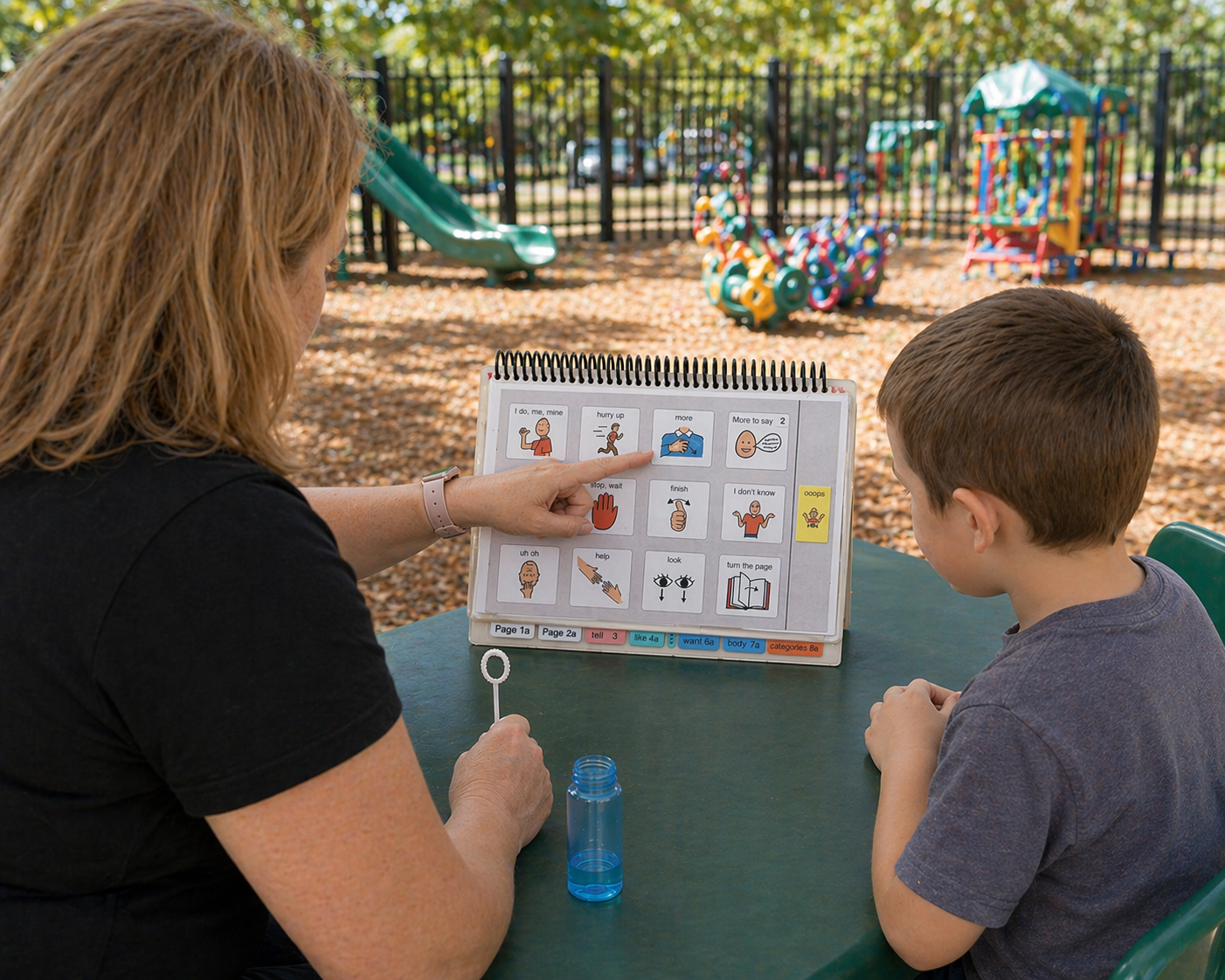
We also offer AAC (Augmentative and Alternative Communication) assessments, trials, and implementation to support individuals with more complex communication needs.